RV & Motorhome how-to
Onan RV generator maintenance, by the hour
How to maintain an Onan RV generator by engine hours, with the real schedule from a 2020 Tiffin Allegro Red 33AA’s 8 kW diesel Onan, plus what differs on gas models.
Published
An RV generator is a second engine, and it wears by the hour, not the mile. A coach that barely moves all summer can still put hundreds of hours on its generator. One that drives across the country may barely use it. If you service the generator on the chassis schedule, it will be wrong one way or the other.
This guide explains how to keep an Onan generator on an hours-based schedule, using the real schedule and service history from our 2020 Tiffin Allegro Red 33AA, which has a Cummins Onan 8 kW diesel (model 8HDKAK).
On this page: Hours, not miles · Our schedule · Water pump · Slide-out vs. drop-out · Gas vs. diesel · Exercise and storage · FAQ
Hours, not miles
Most Onans have an hour meter, on the remote panel inside the coach, on the generator itself, or both. That reading drives the schedule. Most items are due by hours or by months, whichever comes first, because oil and coolant age even when the generator doesn’t run.
Make it a habit: write down the hour meter reading every time you service the generator, and whenever you log anything else on the coach. Without the readings you can’t tell when 150 hours have passed.
A real schedule: our 8 kW diesel Onan
These are the intervals on our coach’s generator, set from the Onan manual for this model. Your model’s manual may differ, so use it to set yours.
Every month
- Clean and check the battery.
Whenever the generator is out for service
- Have the water pump’s weep hole checked for leaks (see the water pump below). On our coach you can’t reach it with the generator installed.
Every 150 hours
- Change the oil and filter. On our coach this is also due every 12 months, whichever comes first.
- Clean the spark arrestor.
Every 500 hours
- Replace the air filter.
- Replace the fuel filter.
- Check the coolant’s antifreeze protection.
Every 1,000 hours
- Flush the coolant system.
- Replace the coolant pressure cap.
- Replace the V-belt.
- Clean the crankcase breather.
- Replace the thermostat and the coolant hoses. Our technician’s practice is to replace only the top radiator hose, which takes the most heat because it sits at the top of the generator, and to inspect the other hoses and replace them only if they are cracked, soft or swollen. Your manual may call for more.
The 1,000-hour service is the big one. On our coach it came due in the summer of 2026, and we did all of it in one visit at the end of August. The oil change before that was in late October 2025, so the next one is due by the end of October 2026 at the latest, or sooner if the generator reaches 150 hours since that change first.
The water pump and its weep hole
On a liquid-cooled diesel Onan, the water pump that circulates the coolant is a wear part and gets replaced. It has a small weep hole below the pump’s shaft seal. When the seal starts to fail, coolant seeps out of that hole before the pump fails outright.
If your generator slides out, look at the weep hole every time you service it. If it has to be dropped, like ours, you can’t see it in place, so ask the shop to check it every time the generator is down. A wet spot, drips, or a crusty white or colored trail of dried coolant under it means the seal is going, and the pump needs replacing. Catch it then, and it’s a planned repair. Miss it, and the generator can lose its coolant and overheat in the middle of a hot afternoon.
Getting to the generator: slide-out vs. drop-out
How hard the 1,000-hour service is depends on how the generator is mounted:
- On a slide-out tray, the generator rolls out from its compartment, and the belt, hoses, thermostat and water pump are within reach. Many owners can do much of the work themselves.
- On our Tiffin, the generator has to be dropped out of the bottom of the coach. That means getting the coach up on a lift, so for most owners the 1,000-hour service, and a water pump replacement, is a shop job.
Find out which kind your coach has before the service comes due. If it drops out, book a shop with a lift that can take a motorhome, and have them do the whole 1,000-hour list, plus the water pump if the weep hole shows any sign of leaking, in the same visit.
Gas vs. diesel Onan generators
Most motorhomes have either a gas Onan or a diesel Onan, and the schedules differ:
- Gas: spark plugs on an hours schedule, plus an air filter, fuel filter and oil change like the diesel. Gas generators are sensitive to stale fuel. Add stabilizer when the generator will sit, and run it regularly so fresh fuel moves through the carburetor or fuel system.
- Diesel: no spark plugs, but a liquid cooling system and a drive belt to service, and a fuel filter that matters even more because water in diesel fuel damages the injection system. Diesel fuel keeps better than gasoline, but it still needs the regular exercise runs.
Either way, many generators draw from the coach’s main fuel tank, so what you put in that tank reaches the generator too.
Exercise it and store it right
A generator that sits is harder on itself than one that runs. Onan’s manuals call for running the generator regularly under a real load, such as the air conditioners, when it isn’t otherwise used. At least half the generator’s rated load is a common guideline. That keeps the seals lubricated and the fuel moving. Check your manual for how often, for how long, and how much load.
Before the coach goes into storage:
- Change the oil if it is close to due, so old, acidic oil isn’t sitting in the engine.
- Treat the fuel the way your generator manual says, especially on a gas unit.
- Keep the batteries charged. The generator usually starts off the coach batteries, and it won’t start on a flat one.
- Keep up the exercise runs if you can reach the coach during storage.
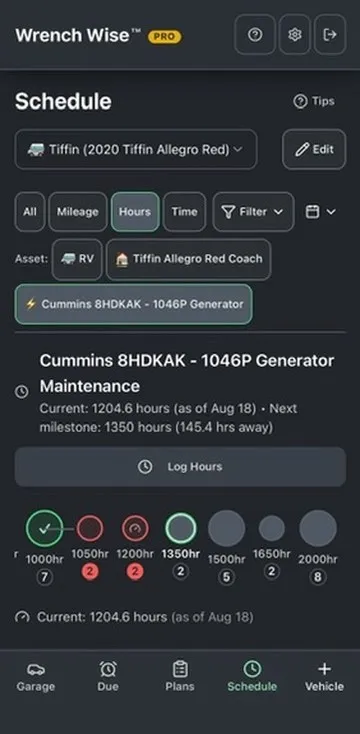
Keep the generator on its own schedule in Wrench Wise™
In Wrench Wise™ the generator is its own entry on the coach, with its own hour meter, separate from the chassis miles. Each item is due by hours, by months, or both, whichever comes first, and you log the hour meter reading when you do the work. That is how our oil change works: the app watches both the 150 hours and the 12 months and shows it due at whichever comes first.
A new RV starts with a generator schedule you can adjust: oil every 100 hours or 12 months, an air filter every 200 hours or 12 months, and a yearly load test. A gas generator also gets spark plugs every 500 hours and fuel stabilizer every 6 months. A diesel gets a fuel filter and water separator every 200 hours or 12 months instead. A liquid-cooled unit gets coolant every 1,000 hours or 24 months. We changed ours to match the Onan manual for our model, and you can do the same for yours.
Wrench Wise™ is not affiliated with Cummins, Onan or Tiffin Motorhomes. This guide describes one owner’s generator. Your generator’s manual is the authority for yours.